Why Early Learning Needs More Attention: Podar Prep Shares Insights on Preschool Education
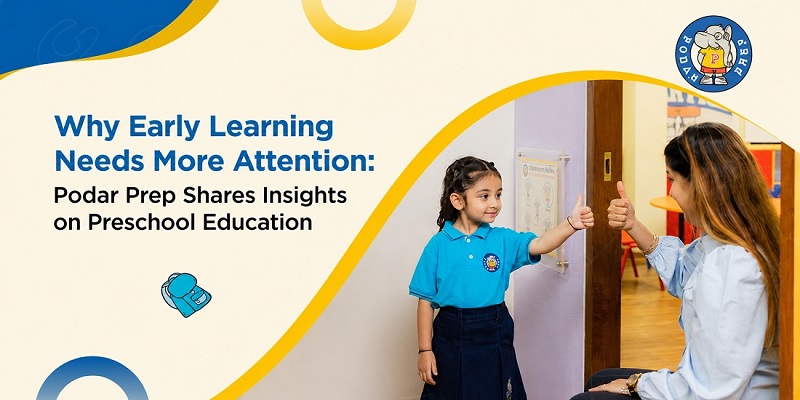
Ask most parents when their child’s education really begins, and many will say: when they start school. But science, and India’s own National Education Policy (NEP), would disagree.
NEP 2020 recognises that over 85% of a child’s brain development occurs in the first six years of life, making the preschool years not just relevant but critical. Yet 74% of parents underestimate the long-term risks to a child’s future, viewing early learning struggles as just a phase.
Podar Prep, one of India’s top preschool networks, believes it is time to change that.
The Science Behind Early Learning
A child’s brain grows to about 80% of adult size by age three, and about 90% by age five, a pace of development that is unmatched at any other point in life. In its early years it makes over a million connections every second, making early childhood a critical period for shaping cognitive, emotional and social development. The importance of early learning, then, is not a soft parenting preference; it is a neurological reality.
Research shows that high-quality early education leads to better vocabulary, language, maths and social skills, more positive relationships with classmates, and higher scores on school-readiness assessments. According to the Annual Status of Education Report (ASER) 2024, more than half of Grade 5 students are unable to read a Grade 2 level text, a sobering reminder that foundational gaps formed in the early years do not quietly resolve themselves.
Recognising these challenges, early childhood educators are turning more and more to developmentally appropriate approaches to support foundational literacy, numeracy, critical thinking, and socio-emotional growth during the preschool years. This is where curriculum design plays a crucial role.
Where Podar Prep Comes In
Founded in 1927 and with an educational legacy of over a 100 years, Podar Prep approaches preschool education through a philosophy called ‘Kiducation’, which considers education entirely from the child’s point of view through developmentally appropriate practices. The curriculum is powered by a Triple Impact approach:
- T.R.E.A.M (Science, Technology, Reading and Writing, Engineering, Arts and Maths)-based activities are designed to build problem-solving, critical thinking, collaboration, and innovation skills.
- The Spiral approach, inspired by Jerome Bruner’s model, revisits concepts with increasing complexity to ensure continuity and connection.
- Stories anchor it all, building Higher Order Thinking Skills (H.O.T.S) while making learning feel like a natural journey from the familiar to the new.
Programs That Address the Real Gaps
Podar Prep’s offers foundational literacy and numeracy (FLN) programs as per Nipun Bharat which is the most essential in preschool education awareness.
- Symphonics – The Reading and Writing whole language phonics based program that builds foundational literacy skills in children.
- Number Magic Numeracy Education Program uses a multisensory approach to build a strong foundation in Math using the Concrete-Pictorial-Abstract (CPA) way of learning that caters to all kinds of learners.
Your Child’s Best Head Start Begins Here
What sets the best play school experience apart is not just what happens in the classroom; it is how learning extends beyond it. If you are a parent of a child under six, this is your sign to get curious.
With its Kiducation philosophy and research-informed curriculum, Podar Prep continues to advocate the importance of quality preschool education and the lasting impact it can have on a child’s development. To learn more about Podar Prep’s approach, visit podarprep.com.