Measuring the Impact of Physics Tuition Beyond Short-Term Test Scores
A higher mark after several lessons can be encouraging, but one test provides limited information about what changed. The paper may have contained familiar questions, covered recently practised topics or suited the student’s strengths. A lower mark can also occur even when reasoning has improved, especially if the assessment is harder or tests different content.
When parents evaluate a Best Physics Tutor, they need evidence that extends beyond the latest percentage. Useful tuition should help a student retain ideas, recognise principles in unfamiliar settings, explain decisions and correct errors with decreasing assistance. These changes usually provide a stronger picture of progress than one short-term result.
Start with the Quality of the Student’s Thinking
Marks record the outcome of performance under particular conditions. To understand learning, examine how the student reached the answers.
Compare work from before and after tuition. Look for changes in the first few steps of a solution. Does the student now draw a relevant diagram? Can they identify the system being analysed? Do they distinguish given information from a quantity that must be calculated?
These details matter because a correct final number can result from a memorised procedure, a lucky assumption or genuine understanding. Similarly, a wrong number can follow an appropriate model and a minor arithmetic error.
The purpose is to identify which part of the process has improved and which part still requires attention.
Distinguish Immediate Performance from Retained Learning
Students often perform well on a question immediately after seeing a closely related example. The method is still active in working memory, and cues in the exercise may indicate what to do.
A more demanding check takes place after several days and without the original example beside the student. Can they reconstruct the approach?
Suppose a lesson covers resultant force. During the lesson, a student correctly subtracts an opposing resistive force from a driving force. A week later, the new question describes a falling object with weight and air resistance. If the student again identifies the resultant force and its direction, the underlying reasoning has transferred.
If the student succeeds only when the forces are arranged exactly like the original example, the knowledge may remain tied to one surface pattern.
Parents can ask to see delayed reattempts or changed questions. Retention does not require perfect recall of every detail. It means the student can recover the relevant principle and rebuild the method.
Track Independence, Not Just Completion
Completed homework can conceal how much help was needed. A student may finish every question with repeated prompts from notes, model solutions, a tutor or a family member.
Record the type of assistance used. There is a meaningful difference between receiving a reminder to draw a diagram and being told which equation to use.
A simple progression might look like this:
- The student completes a question with the method demonstrated.
- The student completes a related question after one strategic prompt.
- The student selects the method independently.
- The student handles a changed situation and checks the answer.
Progress should gradually reduce the support required. If the same full prompt remains necessary, more completed pages do not yet represent greater independence.
This measure is particularly useful for students who appear confident in lessons but become stuck during school assessments.
Examine Transfer to Unfamiliar Questions
Physics assessments rarely present every concept using the exact wording and diagrams seen during revision. Students must recognise familiar principles inside unfamiliar contexts.
Consider two illustrative questions. One asks for the electrical power of a fixed resistor connected across a stated voltage. Another describes the rate of energy transfer in a heating element without using the word “power”.
A student who understands the relationship should connect both situations to energy transferred per unit time. A student relying on keywords may treat them as unrelated.
Transfer can be tested by changing one feature at a time:
- Ask for a different quantity.
- Change the diagram while preserving the principle.
- Include irrelevant information.
- Present the data in a graph or table.
- Ask the student to justify an assumption.
The aim is to show whether the concept remains usable when the presentation changes.
Review the Nature of Errors
An error log becomes useful when it records causes rather than chapter names. “Waves” says where the error occurred. “Used wave speed without converting centimetres to metres” describes the decision that needs repair.
Group recurring errors into categories such as:
Modelling and interpretation
The student misunderstands the physical situation, selects the wrong system or overlooks a condition.
Principle selection
The student knows several equations but cannot decide which relationship applies.
Execution
The model and relationship are appropriate, but algebra, units, substitution or arithmetic fail.
Communication
The idea is partly correct, but the explanation lacks a necessary causal link or uses an imprecise term.
Examination management
The student spends too long on one question, misreads instructions or leaves accessible marks unfinished.
A useful tuition programme should change the distribution and recurrence of these errors. For example, calculation slips may remain occasionally, while major modelling errors become less frequent.
Assess Explanations as Evidence of Understanding
Physics understanding should be visible in words as well as calculations. Ask the student to explain why a method works and which conditions make it appropriate.
For example, saying that an object moving at constant velocity has “no forces” is incorrect. A better explanation states that its acceleration is zero, so the resultant force is zero. Individual forces may still act and balance.
After tuition, check whether the student can make this distinction without reproducing a memorised paragraph. Change the context from a vehicle moving on a level road to an object descending at terminal velocity. The forces differ, but the relationship between constant velocity, zero acceleration and zero resultant force remains.
Precise explanations also make future errors easier to diagnose. A tutor can see which link in the reasoning is missing.
Compare Similar Evidence Fairly
Scores from papers of different difficulty should not be treated as directly interchangeable. A student may earn the same percentage on a more demanding paper while demonstrating stronger reasoning.
Where possible, compare similar tasks over time. Review performance on motion graphs, force modelling or circuit explanations across several assessments.
Consider the conditions too. Was one paper completed with notes and unlimited time while another was a closed-book test? Was the content recently revised? Did the school change the question format?
No single comparison will be perfect. Looking across several forms of evidence reduces the chance of drawing a conclusion from an unusual paper.
School feedback remains important. Tuition progress should eventually support the work students are expected to complete in their actual course, whether that is O-Level, SEC G3, IP, H2 or IB Physics.
Include Study Habits That Affect Learning
Tuition can improve the quality of a lesson, but the student still needs time to revisit difficult work. Track whether follow-up practice happens and whether it is purposeful.
A useful routine might include a delayed reattempt, one changed question and a brief explanation of the corrected principle. This provides more information than completing a large undifferentiated worksheet.
Also observe whether the student begins to ask more precise questions. “Why is the normal contact force not equal to weight on this slope?” shows a clearer learning need than “I do not understand forces”.
Improved help-seeking, better organisation of working and willingness to test an answer can all support later performance. They should be connected to actual Physics work rather than treated as general impressions.
Set a Review Point with Specific Evidence
Before tuition begins, identify two or three learning goals based on marked work. These might include interpreting gradients correctly, distinguishing resultant force from individual forces or writing complete energy-transfer explanations.
At the review point, use new questions to test those decisions. Avoid relying entirely on the same worksheet that was taught.
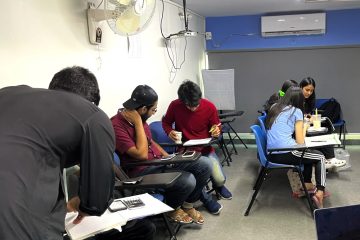
TGC ACADEMY describes small-group teaching, structured resources and personalised attention as part of its approach. Parents considering this provision can ask how individual misconceptions are identified, how students are checked after guidance and how progress towards independence is recorded.
A useful review can acknowledge mixed evidence. A student may understand circuits more securely while still needing help with practical evaluation. This leads to a focused next step rather than a broad judgement that tuition is either succeeding or failing.
The strongest sign of impact is a student who can retain a principle, recognise it in a changed situation, explain the reasoning and complete more of the process independently.